Okay, so in the interest of getting back into the spirit of the blog I’m going to tell you a little about the substance of Reltash, how I’ve chosen to place in the scope of the multiverse and how that placement sets it apart.
First and foremost as ever one must look at Earth, and as I am the writer, that happens to be the Earth I grew up in. Since I was a tiny little fingy I’ve always had an interest in the occult, despite (or because of) being given several firm prods towards Christianity. After I started reading fantasy, I was interested in viewing Earth in the same way, with a firm set of principles to govern ‘magic’. I wanted a clear set of rules and regulations, definitions, labels – you know. Librarian stuff.
DeLorian through time a few years once I became a bit more sceptical and a lot more well read and you will see numbers. Not maths, but a clear and present force of numeration across the High Fantasy realms. In The Book of Atrus the number five has a recurring effect within the world of Riven, so too does Vivec state that on Nirn five is ‘the number of the limit of this world’. Garth Nix has the Old Kingdom, a ‘bubble’ existing within another world, governed by nine great spirits who split Death nine ways between them. Tolkien proclaims that his great work is the ‘Middle-Earth’, which implies three Earths already exist at the very least.
It has therefore fallen to me as the only one crazy enough to notice such things to assign a number to our own world, and though it is tempting to let that number be ‘1.618’ I chose ‘7’ because it is prettier.
Why seven? That’s the Christianity coming out of me. It’s also a great number to work with because there is plenty of space on each side of it, and plenty of room to approach the idea of what the numbers mean.
In doing so, I decided that once they were laid out it was best to view them chronologically. World 1 is the first world, World 2 is the second, World 3 is the third, so on and so forth. But why in the multiverse would anyone wish to create more than one Earth? What are they driving at here?
Observe:
World Zero:
With a sparkle of the imagination, Disc World. Isn’t a disc just another type of Zero waiting to be discovered? (ha ha). A chaotic and unstable place that hardly manages to stay upright.
World 5:
Equally Nirn, Riven and Middle-Earth. In these places magic exists, but it isn’t exploding from every pore. There are certain rules in place – particularly in Riven – which govern the world and keep it stable. Magic is a far off entity drawn into existence by certain objects or people.
World Seven:
Earth. Magic is hidden and debatably non-existent, held by ‘miracle workers’, ‘gods’ and ‘demons’. Most magic isn’t seen as an independent force, but is granted to followers of certain powerful beings. Most recently in history we have played witness to a decline in mysticism, with science and reason coming to the foreground as immutable factors in the universe.
World 9:
The World of The Old Kingdom. This can be interpreted in two ways: either that of the original world, where science has existed in absence of any gods and religious worship, or that of the Kingdom itself, where magic is governed by Charter Symbols used to draw upon the elements of the Nine Great Spirits. I for one opt for a bit of both. The Spirits can be seen as an underside to the cold technological world, who never impacted it directly until forming the ‘bubble’ that is the Old Kingdom. It was by bridging this dichotomy that magic entered the Ninth World, though the initial barrier was greater than any of the worlds that came before it.
So if you bear with my madness, you can probably see what I am driving at. The creation of these Earths is an attempt to sever a world from the source of Magic, whatever that may be. On one side we have the chaos of Discworld and at the other we have the sterility of Nix’s Ninth. I chose a mix; something close to the exact science of our own Earth blended in with the unpredictable element of magic. My world is the Sixth, where magick is governed by an ironclad set of laws which can only be manipulated through careful study and practise.
As to what separates it from our Earth, I turned to the weekdays we name for the seven days of Genesis. Our seventh is Sunday, the day of Rest. Without rest, The Sixth World immediately became Reltash, ‘The Restless World’, because that is what set it apart from our own. Classically this is seen in the original actions of Reltash’s sculptor, Volianor, who was not satisfied with the world he made and left the universe to create another (His Seventh. Naturally I do not associate him with Yahweh, or suggest he made Discworld or Middle-Earth or any of those places. Reltash was just his sixth world, and just because Earth was Yahweh’s Seventh doesn’t mean Volianor and Yahweh and Terry are all the same person).
In the course of leaping from conclusion to conclusion I happened upon what is now one of my favourite words: Hexaemeron. Hexaemeron is the name of the first part of the book of Genesis, detailing creation as it was in the first six days. Thus Reltash had to have its own Hexaemeron – an equally holistic and interpretative text of similar authorship. The main difference between the two is that the Hexaemeron of Reltash could not be written by the universe’s creator, because he had moved on without pausing to consider his creation. Instead that task fell upon his ‘daughter’, a by-product of creation who acted as witness to everything that came after him and who gathered what information she could about what came before she was born. This was Selayuth, the goddess of Mystery (all the deities have a particular domain) and it was her who ultimately unleashed magic on Reltash.
Giggle. I’m getting ahead of myself here. This post isn’t about Selayuth’s Hexaemeron, but rather about Hexaemer. Hexaemer was how I separated Reltash from the other worlds. Put simply, it is the written substance of reality, which Volianor used to shape the universe. I focused on the symbol

Which as you can see is made of six intersecting lines of equal length, six in six, if you consider perpendicular lines, which makes twelve. Ironically twelve is as important as six in Hexaemer, but more on that later.
The importance put on the value of each degree of ‘unmagiciness’ can’t be overstated. Each line is essentially another absolute law which has to be present in everyone and everything in the world in order for it to exist. The best way to look at this is through the scientific understanding of ‘dimensions’.
Since the dawn of geometry, three laws of dimension were immutable: an object has length, an object has width, and an object has height. Without one of these – no matter how small – an object is said not to exist. This is of course pure supposition and we can laugh at mathematicians because they can’t actually prove something won’t exist without one of these dimensions until they break their own rules. Ha ha. Anyway.
Then last century a fellow came along and said ‘what about time?’ and everyone else was like, ‘What about time?’ and he was like, ‘Well, an object can’t exist without being pinpointed somewhere within the spectrum of time either, so time is one of the cardinal dimensions’ and they were like,
‘Oh. Whoops.’
So now time, width, breadth and height are the four cardinal dimensions of our universe. That we know of. Naturally there is a good deal of argument about this, because there are supposedly dimensions human beings cannot fathom with only five senses, and others that they can’t prove to be essential one way or another. That’s where Hexaemer steps in.
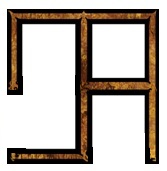
To make things more confusing I inverted the lines. Blank spaces are representative of laws or ‘limitation’ whereas visible lines symbolise freedom and ‘possibility’. This is because rather than creating a world from nothing Volianor is in fact negating possibilities with strictures so as to shape structures, get it? Good.
Anyway, the most important of all the Sigils is the ‘Eternity’ symbol, and is the face of Hexaemer:
It also stands for other things like ‘possibility’ and ‘limitlessness’ (and ‘womb’ for the Kerowackians out there).
Next come the half-measure removals, things like

. There are twelve of these, and they are Reltash’s Absolute Dimensions.
Hang on, didn’t I just say there are only four dimensions on Earth? Why yes, esteemed reader, you are right. Have a biscuit.
I added and conjoined a few. Namely; temperature, illumination, density, size, time, corporeality, speed, sound, spectrality, colour, direction and meaning. I’ve decided that once these things reach any actual ‘zero factor’ the universe starts acting too darn strangely to be classified as ‘within the bounds of its universal dimensions’. What lies outside of those dimensions is another story.
Exciting, isn’t it? Not only do I get to write about diverse subjects such as history, biology and cosmology, but it falls to me to reinvent the very laws of nature. It’s slow work, but incredibly rewarding. I also expect at least some of my theories will be proven right over the course of time.
For example, Speed is considered a scalar quantity while Direction is a vector. This is a problem. I don’t know why, but it is.
I had to consider a new way to think of Direction as a scalar quantity. This wasn’t so hard. All you have to do is keep adding directions – which is fairly regular, since most things are moving down and elsewhere at the same time. I suppose the real problem is with the intensity of the Direction. For instance, Speed is scalar because no matter the number of speeds applied to an object it will still move, and that movement has a set rate. Direction can have any number of directions resulting in one overall trajectory, but that trajectory doesn’t have any degree of intensity... until you consider it as a tug of war. If several things are pulling an object in a single direction then it does have intensity, even though that intensity could easily succumb to a single larger pull in another direction. The trouble with science is that everything is always touching – temperature determines density determines size determines speed determines sound determines meaning etc. It all eventually blurs together – which is why without any of these things, I believe the rest would fall apart. Sure, I settled on twelve, but I’m sure there are more. Those twelve were just the focal point for a good story – and hey, I’m a writer before I’m a scientist.
Hexaemer is a language unlike any I have seen attempted in a fantasy setting – one that does not evolve or adapt, because it is considered perfect and sacred in its original form – kind of like how Sanskrit, Hebrew and Latin are viewed today. It also does not follow the classic function of most languages in that it is not meant to be easy to use or allow any instantaneous transfer of information. Its primary function is to describe something completely, along with its past and future, all it has caused and all it has affected. What’s more it is not so much a transcription of data so much as it is an ‘aura’ of data written into the very fabric of an entity, and even more pointedly, that fabric itself. The best way to look at it, I suppose, is as the smallest divisible unit of matter. As such even the most basic elements that comprise The Sixth World are made of words, whose bonds are in syntax and grammar rather than energy and valence. It isn’t difficult to imagine what it might be like; having one image made up of a thousand smaller images, and one of those images made up of a thousand more.
‘Magick’ on Reltash is a matter of knowing or ‘reading’ what makes up an entity, and then erasing certain words to substitute them with something else. It would be a highly complex field of study which requires years to breach.
Yet even so, I have to admit I am a great fan of the Dungeons & Dragons phenomenon, not only for the storytelling aspects but also for the strictures of the gameplay, where there are precise ‘classes’ to define what exactly a character can do. This ‘class’ system has carried over into so many different fields today that it is almost standard to think of books as a ‘magic story’, a ‘thief story’, or a ‘warrior story’ depending on the protagonist.
For those of you who have never had the pleasure of sitting around eating junk food with four or five friends rolling dice and rescuing fair maidens from the clutches of dastardly pony-thieves, there are two main magic-based classes in D&D: The wizard and the sorcerer. The wizard relies on intelligence and education, and is the more bookish – kind of what you would expect of Merlin or Dumbledore, locked up in a tower reading books and preparing everything in advance. This sort of fellow fits fairly well into the Hexaemeric universe. You can almost imagine him searching through ancient spellbooks for the name of one of the 602+ Sigils in the Hexaemeric alphabet to correctly structure a Hex with greater efficiency, and then painstakingly copying out streams of these runic letters to form a larger symbol.
The other kind, the Sorcerer, posed to be a bit of a problem. Sorcerers are ‘natural’ spellcasters, meaning that they are intuitively linked with the forces of the universe and can bend them at will. They do not have the brilliance of wizards, and thus their control over the forces of magic tends to be limited, but in whatever field they do have natural finesse they tend to excel all others. For example a sorcerer may have a knack for defensive spells and can conjure up barriers with ease, but unlike a wizard they cannot link their understanding of barriers to destructive spells because they have no true understanding of the ‘principles’ or ‘rules’ of magic.
On Reltash, sorcerers can be linked to natural speakers or talented musicians, who understand where to put notes and words to maximise their effect without really having an understanding of grammar or vocabulary. They have the ‘it’ factor, like when someone writes a book that just matches up with the thoughts and emotions of its readers without needing any complexity or schooled literary spirit behind it. Remember – everything in Reltash is made of words. Even gestures, exclamations and feelings can align to form a new phrase, and that phrase comes to life as magick.
I’ve gone a bit off track (and been hit by a train, no doubt) so I think I’ll end this one here.
The important points:
- Reltash has 12 dimensions.
- Reltash is made of words.
- The 13 original words are the 12 dimensions and the concept ‘eternity’.
- Reltash is the Sixth World in a line of several attempts to eliminate ‘possibilities’.


