Friday, 27 January 2012

Of Gnomes

Affectionately known as the little folk, few have ever raised complaint against the genteel gnomes of Volianor’s Third World.
Known to their close racial allies the fey as ‘reniil’, or ‘inner light’, the gnomes bear a remarkable physiology, with features ranging from natural camouflage to supernatural nervous systems. Their culture is deeply laced with ancestral laws, and their technology utterly unique within their societies.

Physical Appearances
Gnomes stand no taller than 68 centimetres and no shorter than 43 centimetres, averaging at 53 centimetres tall. They are humanoid, with two arms and two legs, ten fingers and eight toes. They have one mouth, a ‘gnose’ and typically two eyes, though rare genetic lines carry a code for three eyes, with the third placed just above the gnose. They have simplistic ears at either side of their heads with no auricles (skin flaps), though cartilage can build around the ear hole and create a protrudent bump at the side of the head. Rather than hair they grow clumps of fine cilia which can grow as long as 16 centimetres. Gnomes begin to grow tails at the age of 333 years, and their tails continue to grow until potentially reaching double an individual’s body height.

The Gnose:
The centre of a gnome’s face is taken up by a bulky construct referred to as a ‘gnose’ – an advanced organ used to process smells and ascertain their exact direction, and to safely expel mucus. Due to their wide nasal passages, gnomes rarely suffer from sinusitis and other infections within their nasal cavities.
The gnose forms around a central ridge which can often grow with several vertebrae, giving it a humped appearance and increasing its size with age. At either side of this ridge are two long vertical slits and two crescent slits, which routinely open and shut as a small muscle beside the nasal ridge flexes. Gnoses can be very sensitive, and when they are damaged too often they will grow a scaled carapace to protect themselves.

Skin:
Gnomes’ bodies are predominately covered in soft, hairless flesh which offers little natural protection. In areas prone to the sufferance of bumps and bruises they develop patches of minute, iridescent scales resembling those of fish rather than of reptiles. With age their skin loosens but does not wrinkle, rather spreading to cover ridges of crystallised bone which line the limbs and spine as they get older.
Their skin is transparent, but underlined with chromatophores capable of changing their colour to suit their environment. These chromatophores are also sensitive to a gnome’s emotions, causing them to change colour frequently when in a complex social cluster.

Cilia & Tail:
The minute cilia attached to the various nexuses of the gnomish form are at a distance indistinguishable from human hairs. They are incredibly fine, and transparent even when a gnome uses its natural camouflage. Though most gnomes will allow their cilia to grow – though growth is generally slow – those with a particular need for stealth or combat slice them off to harness a practical bodily economy. Cutting the cilia is painless, but will produce a small amount of fluid.
Gnommish cilia curl and flex at their own whim, probing surfaces and offering additional range for their owner’s quasi-electric nervous system.
A gnome’s tail is essentially a single large cilium, boneless and fleshy. They are usually 10 centimetres in diameter but can be much thinner and much thicker than average. Their tails are easily manipulated by a knot of muscles at their bases, and are used in place of walking sticks to assist older gnomes in moving around. Gnomes who grow three eyes also grow tails with three distinct tips.

Biology:
As with any magickal creature Gnomes rely on adaptive aethereal particles within their bloodstream to substitute metallic compounds natural races rely on. However, their adaptation to the reduced aethereal connectivity on Reltash has affected their former levels of dependency. On the Third World (Named Artash by their people) they would release their excess magick into their immediate environment and warp it to their wills, but on Reltash the dwindled excess cannot maintain any exterior structure. Rather, it is simply circulated within their bodies until it eventually settles in their bones, wizening their limbs and making them appear less human as they grow older.
Their nervous system is touched by magick to a much greater extreme than their brothers and sisters the fey. It reacts to quasi-electrical stimulation, giving them a ‘sixth sense’ rather than a true sense of touch. Practised gnomes can even feel pain before any actual damage affects their bodies and make moves to avoid it.

Gnomes have evolved in such a way that the higher tier magicks of the multiverse cause minimal negative temperance to their minds, while somewhat hampering their reasoning and deference to the complexities of Reltash. Their brains are segmented into three distinct sectors each surrounding a neural ventricle and individually capable of basic consciousness. When awake and in a general state of rest these sectors function as one, usually under the guidance of the central sector. When a gnome loses consciousness as a result of magick, however, the sectors remain active individually until an aethereal overload shuts them down. In this way gnomes can discipline their minds into pushing past the limits of ordinary beings and craft a higher tier hex. The circulatory system within their skulls is also much more sophisticated, allowing crystal matrixes formed by magickal overdoses to disperse without any great mental detriment.
Their segmented brains are unfortunately also what causes them to lack the concentration, focus and intellectual drive demanded by the vagaries of Hexaemer. Their brains do not process information as quickly as humans or fey, and without practise a gnome cannot focus his or her consciousness within a single sector, causing them to temporarily forget what they are doing and start from scratch.

Vocally gnomes possess what have become known as ‘honeyed voices’. Their voice boxes are one of the primary sites for the secretion of excess aether, and when carried away on their words they generate an intoxicating vibration which is pleasant to the listener and considered mellifluous by other races.
The excess aether is also vented through their pores, providing them with a natural pheromone after using higher tier magicks. In ordinary circumstances this scent is negligible, but powerful gnomish magickers are known among their people to have a distinct and heavy perfume which follows them wherever they go.
The scales which patch sensitive areas of the gnomish form are grown from aethereal crystal compounds. When a gnome’s skin is broken, a sticky gel oozes through their bloodstream and within hours will solidify into a scale. When an area is frequently harassed, several layers of this crystallised gel mesh together into a notable carapace. Most gnomes will wipe off this gel to prevent bulky protrusions to their body, and leave a thin layer of shimmering scale behind.

Reproduction:
Much like the fey who they name their elfkin, gnomes reproduce my inception rather than pregnancy. A core idea forms the basis of the baby’s soul, while its body grows in an internal cavity and is born within a period of one year.
Gnomes differ from fey in that they have genitalia and can reproduce with a variety of other species. Females can give birth to a small number of faerie races, while males can reproduce with humans and dwarri. Cross-racial reproduction is generally successful, and children born from such occurrences host a wide range of genetic possibilities.

Growth:
Gnomes reach their full height by 33 years and achieve maturity at the same time. Their tails grow much later, as do their cilia, and scales may appear at any age. After four hundred years of age there is a noted decline in their health, and by five hundred they certainly die. Many races have found means to increase their longevity with magick, but such Hexes do not work on gnomes as the higher tier magicks erode the subtleties of the Art.

Reaction to Disease:
As a practically alien species to the world they inhabit, gnomes are susceptible to the worst natural diseases of Reltash. Their antibodies are equipped to fight off only magickal attacks, so while they resist strains of vampirism and handle Faerie Fire with greater fortitude than other races, a simple sniffle can quickly breed into a horrific bout of influenza. For this reason gnomes are wary of outsiders and carry one or two elixirs brewed from mushrooms native to their homeworld which, when ingested, purge the gnome’s system of general bacterial woes.

Culture:
Gnomes are idealistic creatures who uphold simple laws and simple customs. They shy away from the complexities of social interaction common among the races of the sixth world, dismissing them as superfluous and over-complicated. Their laws are ancestral and rarely suffer reform, though a somewhat lax attitude is given to vague and peculiar situations in which laws should apply but will obviously not suit the individual situation. This makes them open to interpretation and provides plentiful wiggle room.

Familial Structure:
Gnomes rear their own young, forming closely knit families who take on distinct roles in a household. The ‘Aema’ is the oldest female, who is responsible for ensuring arguments are seen through and harmony is maintained. The ‘Aena’ is the oldest male, who teaches the family’s young and records the family’s history.
Gnomes older than one hundred work as providers in the house, either earning the coinage required to purchase food and keep the burrows clean, or growing produce and doing routine maintenance themselves. Younger gnomes are given free rein to pursue their interests, assisted by the Aena where possible. Many gnomes use this time to travel and see the world, while others quest for a singular purpose to pursue for the rest of their lives.

Relation to other faeries:
Gnomes have considerable standing among the faerie nation, and are seen as the chief authority in matters of state and law. Gnomes have been the founders of ordered communities in the ancient past of Artash, and were responsible for the magick behind the Third World Exodus. They are often cared for by an assortment of faeries who respond well to their kindness, and gnome dwellings are usually attended to by four or five faeries content to do chores in exchange for food and shelter.
Only one historical record hints at a time when gnomes and other faeries did not co-operate with one another, long before the Third World Exodus. There was a long and fruitless conflict named ‘The Garden War’, which eventually ended in peaceful resolution.

Communal Structure:
It is rare for gnomes to live in societies with more than ten neighbouring families, living in burrows no closer together than a mile apart. These communes meet up monthly for social engagements within nearby mushroom circles, holding lavish parties with their finest produce and favourite music. These parties encourage young gnomes to form lasting relationships with partners outside their own families and allow elders to discuss local matters of significance.
Individual leaders do not exist within gnomish society. Gnomes believe in rationalising things on a personal level and making decisions based on relationships and necessity. If, for example, a gnome believes it is a good idea to build a bridge over a nearby river, he will approach his friends and convince them to help him build it. If another gnome believes that same bridge is causing unwanted travel through the area and has brought criminals to their lands from afar, he will convince his own friends to pull it down. A gnome’s popularity largely determines what results he is capable of achieving on a communal scale.

Criminal law:
Like most races, gnomes have no love of murder or thievery. An act of murder is tried by a community’s elders, and in the presence of a guilty sentence a private execution is performed, by method of magickal disintegration. An act of theft is dealt with between the families involved, and a guilty verdict is dealt with by house arrest until a period of 33 years or sooner closes*.
For obscure crimes, sentences tend to be harsh. Rape, assault and treason (against the race rather than an individual or state) have punishments ranging from execution to dimensional exile.
In Tri’vara, the presence of the Ocean Gates to Artash allow any sentence to be circumnavigated by one willing to serve a permanent exile on the Third World. As no true knowledge has been ascertained concerning that world’s fate – other than the leakage of ‘faerie dust’ – some consider this equal to a death sentence. It remains a popular choice for criminals facing execution.

Matrimonial Law:
Gnomes pair up in romantic partnerships under the presence of the Aema and Aena of their families, enacting an ancient ritual in which an acorn must be given from the male to the female, and a live dragonfly from female to male. While Artash Dragonflies are easy to come by in Gnomble, only certain oak trees exist within the country, and none exist beyond it. A male who wishes to marry will usually travel to Tri’vara and visit Mother Oak, explaining his desires to the tree and hoping for an acorn to fall.
Once bound to one another, gnomes are expected to produce a child as quickly as possible. The way they raise that child is seen to be a reflection of their synergy with one another and an indication of whether the relationship is feasible. Once the child reaches the age of one hundred, they may then consider separation. A separation ritual is very similar to a marriage. The male returns a dragonfly to the female, and the female returns an acorn to the male. Any non-essential property they owned during the marriage is prematurely destroyed.

Property:
Gnomes do not seek any great degree of wealth or beauty beyond what is required to keep their families comfortable. They will trade gems or interesting stones for food or pipe weed, and prefer a cellar full of wine to a pouch full of gold. While they enjoy wearing fashionable clothes, they consider comfort above the value of silk and the weight of jewellery.
After the 333rd year of their life, gnomes no longer burden themselves with material wealth. They live in simple homes with a nest of bedding and little else. The young are expected to provide them with sustenance. Gnomes without families are attended to by their community in return for sagacity or magick.

Clarity Rituals:
Every 33 years, gnomes gather up the non-essential items they have collected and blast them into aether with their magick. While some claim this practise in unnecessary and destructive, gnomes maintain the belief that these ‘clarity rituals’ clear their minds and sharpen their focus for the years ahead of them. Approaching the clarity ritual ‘borrowing’ becomes a common habit, and even theft is not considered any particular infraction to the participant.

Coming of Age:
Gnomes hold marked celebrations for their fellows who reach 100 years, and a similar celebration marks 333 years, when they grow their tails.
At such celebrations, the gnome in question sits in a high chair at the end of a table and is approached by all others in his community, ensuring that he meets every one of them in turn. Speeches are made by his family and dances are had by all.

Courting Rituals:
When one gnome takes interest in another, they show their affection by privately approaching the Aema of their partner’s family and making their intentions known to her. She then must cautiously make sure the partner takes notice of the gnome’s advances and notify him or her of any feelings the partner may express. Positive reactions lead to marriage. Negative reactions are left to the Aema to resolve.

Funeral Rites:
When a Gnome dies, two courses of action are likely to follow. Around Tri’vara the deceased is placed within shrouds and a memorial ceremony is held at the Ocean Gates. The surviving members of the Gnome’s family are permitted to touch the corpse in farewell, after which the body is put through an Ocean Gate and shares the unknowable fate of Artash.
Elsewhere, it is considered too dangerous to allow the body to remain intact. The Aena of the family oversees the family’s ceremony (these functions are, in most cases, private affairs, and are not attended by other families in the area) and is charged with the responsibility of disintegrating the corpse. Any residue left behind after the cremation is shared amidst the family and carried by them in ‘origami’ leaf wrappings. Several of these wrapping designs exist and are used to show the carrier’s relation to the deceased, whether mother, father, sister, brother or other relation.

Attitude to Death:
Most Gnomes tell their children that death is transitory – a long time spent waiting to be received by another world. In this other world they believe they will be born anew knowing everything they did before they died, and their bodies will be old and frail. They are told that in this new world their life will be spent forgetting everything they knew and growing to be strong and young again, up until they become babies and die a second death. After this second death, they live the same life they had before, oblivious to everything that has transpired in the past. Since the Third World Exodus, theories have arisen that death is actually a return to Artash at the height of its glory, at a time when gnomes managed to bend the fabrics of reality and force time to work backwards, ensuring their own immortality. Such theories are, of course, only theories, and no definitive evidence has confirmed these suppositions.
Premature deaths are considered matters of grave misery, as they cast gnomes out of their cyclic rebirth forever and will ultimately end in the extinction of the race. For this reason gnomes are particularly cautious of dangerous situations and will avoid them whenever possible.

War:
While gnomes have held no firm position in any war on Reltash other than the Mortal War, they have an honour code applied to any battle that impedes them. First they undertake defensive preparations. Then, if possible, they enter diplomatic relations. If those fail they will launch a ‘prevention strike’ upon an enemy’s resources, hoping to nullify any ability to prolong conflict. Lastly, they resort to hostile strikes, seeking to eliminate the most powerful agents of the enemy with minimum casualties.
As one might expect from their size and camouflage, gnomes can make particularly talented assassins. While the main body of a faerie strike force engages in guerrilla warfare, select task forces will infiltrate enemy ground in order to eliminate targeted troops. Honourable servicemen will leave the body of their target in a respectable position unlikely to generate anger or prejudice towards their race.
No chain of command exists within their martial practice, though delicate information is freely withheld from those who may unwittingly spread it. Strategists are trusted with this information, and form their own task forces to deal with problems as they see fit.

Names:
Gnomes place great importance on their names, and avoid using them where possible so as to increase their value. In ancient times so much as knowing the name of a gnome would condemn him or her to servitude, so compelling where the ties to secrecy around them. They do, however, prefer to use others’ names with alarming frequency, forgoing pronouns in conversation.
When asked, a gnome will first reveal their family name, which they expect to be called by outside of Gnomble. Within their homelands, they use numeric titles depending on their age, often altering the consonants within the number’s name to suit personal taste. Birth names cannot be changed, and are typically only known by the Aena, Aema, parents and spouse of the gnome in question. Friendly tomfoolery between siblings involve different means of trying to guess, bribe or blackmail a first name from one another – a habit which has made parents uneasy about revealing a name to their child until the age of fifteen.
There are certain occasions when the choice of a name has made it possible to divine it by keen observation. Gnomes love to name their children after the flowers and animals native to their homeworld, and after virtues translated into an archaic tongue.


Magickal Inclination:
Gnomes are regarded as Artash’s supernaturally selected pinnacle of evolution. Their magick is ancient and powerful, and the tasks they set them to rarely fail. Just as magick affects their biology, so too does it affect their culture.

General Use:
Unlike magickers of other races, gnomes cannot set their powers to regular use in minor activities. They are discouraged from using their abilities at a young age and only after overcoming any emotional urges do their elders offer to teach them how to harness their aethereal energies. Before then, random accidents can occur. Thankfully young gnome’s brains are not fully developed enough to fuel overly destructive acts of magick.
Guided meditation starts at an early age, facilitated by both the Aena and the Aema of a gnome’s family. Adult gnomes continue to meditate solitarily, and elders are known to meditate almost constantly, lapsing into quiet contemplation at every dull moment.
The clarity rituals are undertaken personally, and consist of nothing more than a blast of pure force or elemental energy. Executions are undertaken by multiple participants striking with equal and united conviction.
In dire situations, gnomes use magick reflexively to stay alive. These hexes are often so colossal they destroy the gnome as quickly as they do his or her enemies.

Gnommish Magickers:
Gnomes are naturally fascinated by the Sixth World, even without seeing their homeworld Artash and the true extent of its nature. When a gnome decides to pursue magick as a discipline, they generally devote some years to contemplating the vagaries of Hexaemer and practicing its use. They never truly master it as well as a fey, just as the fey never truly master the higher tiers.
Gnomes with a talent for using Hexaemer can create incredibly powerful higher tier enchantments, long-lasting and long-reaching. They use their magick to aid their communities or to establish small holdings of their own. Many construct towers in the manner of fey, while others reside in trees or mushrooms with unbound spatial housings.

Technology:

Architecture:
Gnomes live in burrows, using magick to hold the earth around them steady before tunnelling extensively below ground. They line the walls with moss and flowers, keeping the tunnels bright with crystallised light. Whole families live within a single burrow, including their faerie accompaniment. Permanent dwellings will also have an antechamber on the surface of their home, made of monoliths and megaliths recovered while tunnelling. When these structures are roofed or walled, a thin crystal lattice serves to keep out rain and wind.

Gates:
The best known work of the gnomes is in the dimensional gateways they used to escape Artash. Spanning the wills of thousands of gnomes working in consort – often sacrificing their own lives in the achievement of their families’ exodus – the gates are debatable the single greatest achievement of ANY race.
The gates function off an annihilation of the barrier between Reltash’s universe and that of the Third World. Reasons as to why these universes were more closely bound to one another than to their neighbours are linked up to Demani, god of dreams, and his experiments with the core limitations of Hexaemer.
At the points of the barrier’s demolition, shards of Artash collided with the sixth world, allowing millions of faerie to pass through from the transitory dimension that had kept them alive for countless years in limbo.
Structurally the gates continue to exist, though the Lineage have made efforts to reduce a collapse of universal structure entirely. Third World Rifts exist as portals which appear to lead directly across to Artash, but appearances are deceiving. Though the dimensional doorways are in effect joining points between two separate worlds, they are also portals to completely different times. When a portal is used, an amount of time passes for the user without any measurable quantity. The transferral may spend as much as a million years and none would know until walking into Artash and back to Reltash without pause. Even then, it is supposed that the stasis fluctuates in length.

Tools:
Gnomes have learned to use crystal to channel magick in the same way as magickers of other races, and do not hesitate to create crystallised light when they need it. Refined use of magick is more difficult, and to do so they have developed filters with which to better control their energies.
A gnomish filter is a stone device pitted with gemstones. It is shaped almost the same as a conch shell, with a curved tunnel bored through its centre. When undertaking acts demanding exactness and focus a gnome will hold this tool up to their face or rest it against their forehead, using it to funnel their energies and keep them closely together before launching them out as a hex. These filters are kept close at hand by magickal architects and spellcasters, sometimes attached to their wrists or worn as a headpiece.

Resources:
When faced with physical tasks, Gnomes make frequent use of water. Tunnelling is only undertaken with the aid of a hose and water tank, as are similar activities concerning boring and working stone. They use live vegetation rather than dead wood when performing carpentry, spending as long as a hundred years guiding the growth of a tree to suit their purposes.
Gnomes never use metal in any of their machinations, as its very presence causes damage to the magick they depend on. The hardest material they will ever use is granite, when they find it, and this will substitute for most of the purposes they could put metal to.

Chemistry:
Many gnomish families are renowned for the recipes passed down within them, by which they can apothem many unique potions and dishes enkindled with the supernatural effects of Artash’s native vegetation. Pick-me-ups are commonly kept in stock to fight off colds and fevers, though many more exotic beverages exist. Philtres are passed down with reluctance, though they continue to exist and cause all manner of troubles, and metamorphic tinctures are occasionally used by those who wish to pass themselves off as human.
True examples of studied chemistry are rare – as gnomes do not use metal – and are avoided by most. Rather there are those who consider themselves alchemists, capable of turning ordinary specimens from the entangled worlds into marvellous mixtures surpassing natural limitations.

Machines:
Gnomes are considered remarkable among the human race for constructing not even the most simplistic mechanical devices. Such things as mills, pulleys and winches are never even considered as necessary amendments to physical toils.
While unnecessary and unimplemented, they have no particular qualms about using machines. If, for example, a human has moved out of the country and left a mill in working order, a gnome will operate it for his own purposes until it eventually breaks, upon which time he leaves it to fall into further disrepair.
One exception exists in gnomish history, telling of how a young gnome sought the aid of faeries to achieve flight. He built a machine which would be known to later generations by the name ‘Ingenium’, powered by hot air and legwork, and directed by the angling of leather wings. Ingenium was lost long ago in The Third World Exodus, though it remains a popular bedtime story for young gnomes, and is a subject of fascination for historians. If its existence were ever proved, it would make several curious suggestions concerning the gnome’s distant past, particularly as gnomes are currently believed to have eschewed any investigation into scientific principles.
  
Famous Gnommish Persons:

Armadillo Set:
BM 699 - BT 266
Armadillo spent his youth in the Gardens of Artash, ages before the widespread consumption by faerie fire throughout that world. It was his intention after his first century of self-discovery to become a master of Gnommish Magick. He was apprenticed to an elder of Clan Pelo (at that time a legendary bloodline of gnommish sorcerers) and began instruction in the field of Ectomancy, a popular choice given the slow reintegration into eternity the Third World faced and the heroic possibility of saving it.
Armadillo Set was among those chosen to facilitate the matters of the Third World Exodus from the inside of the limbo-bypass. He was seen as too valuable a student to offer up as a mana-sacrifice and not trained enough to deal with any disasters on the Artash-side of the gateway.
Once the Exodus arrived on Reltash, Armadillo disappeared amidst the general confusion of the landing. Like others in his position he is believed to have spent years reuniting with family and friends he had separated from during the event. The Sets are now recorded to have landed not far from Tri’vara and settled by the ocean in the south of Gnomble, though no record of Armadillo appears until BM 858, when he presides over the Shuwwir festival in the area.
Armadillo is believed to have assisted the fey in their ectomantic restoration of Reltash’s wards in Tri’vara, and while doing so it is suspected that he first became exposed to Hexaemer. He took a strange path for one of his kind in that he thereafter devoted himself to the study of Sixth World magick, learning its intricacies with an eager mind. None quite know when or how he became famous for his skill, but it was immediately sought after by the fey at the dawn of The Mortal War.
Armadillo was assigned to facilitate extra-dimensional communications when the war began, though after they lost their first battle Armadillo took the place of the fallen fey commander Keiras’Ccay’Vvint. Armadillo proved himself a tough adversary, using his powers to track dwarri scouts through the subterranean caves of Stragenthor back to their cities. After successfully holding up a blockade between Flamewatch and Central City for several weeks he and four of his fey compatriots vanished, taken prisoner by the dwarri.
The dwarri do not like to share information about The Mortal War or the tactics they used to interrogate prisoners, but those who eventually returned to daylight were tight-lipped and changed by what had befallen them. Such was Armadillo when his release was negotiated at the end of BT 10. He returned to his family for no longer than one Shuwwir before vanishing entirely for several hundred years.
The fey Tharian’Set is credited with finding Armadillo living as a hermit in the swampy Raj’jik Delta. The pair became attached by a scholarly bond which did much to heal Armadillo’s mind in his veterancy. Once he returned to Li’amora, Tharian reported that Armadillo had died in BT 266, making him 499 at the age of his death, the oldest gnome in the whole course of history up until this very day. Amidst speculation by gnommish scholars and the Set family Tharian begrudgingly revealed that he knew Set’s first name, a fact that was quickly verified and shared with the genealogical community.

Thursday, 26 January 2012

Genres: An Analysis of Interpretive Writing

 People who are interested in the Arts have come to classify them in several ways in order to best understand what they are in for before they consume information en-mass. As with most things there are layers of these, and in classic human form they are jumbled together in no particular idiot order.

In the case of stories, we are usually told what the plot line is, in general. Crime. Mystery. Romance. Adventure. So forth.

But this isn't the only way to classify a story, and is often a pretty daft way to classify them anyway because they blend together very quickly – crime usually only has value because it contains a mystery as a subtext, and Romance will almost invariably involve some sort of conflict based on misunderstanding or scheming – hence, mystery also.

The other 'better' way (opinion here) is not in telling the browser what the story is about, but rather how a story is told. Mostly that's what we are really concerned about anyway – the emotions we feel as a result of the experience, and whether we can extract any inspiration or knowledge through it.

Thus, we are left with a large number of evolving narrative forms which have become popular over the years.

Realism:
It may seem like an odd place to start, considering it only gained popularity as an artistic outlook in the past two-and-a-bit centuries, but Realism is the essential core of perception, because as an art form it aims to act in accordance with scientific perceptions. Realism, when achieved correctly, doesn't rely on 'fated' encounters or 'poetic' events. It deals with facts, clear and simple. It is immediately separable from most narrative styles because characters don't just run with their emotions – they fight against themselves, and at times logic or practicality can succeed over love or revenge. Check out your mental library – how often does that actually happen? Most of the time stories are about the successful actions of one driving emotion behind a character, and do not consider that not all people get swept up in a story and can act in ways that fight the limbic system. Consider the painful voyage to marriage taken by Elizabeth and Darcy in Pride & Prejudice; Darcy in particular falls prey to his sense of propriety on many occasions. In War & Peace we are given a host of characters whose actions are measured over the course of several years – because it is written from a Realistic perspective, 'love' is considered as a more fleeting emotion than it is generally described – intense, yes, but fleeting – and is oft bound up in the colder intentions of royalist Russia.

Dramaticism:
Drama is at least as old as the Greeks, and probably older. It originates on the stage – an early form of storytelling – and is by far the most popular of the three main groups of narrative perception.
In direct contrast to Realism, Drama is in the triumph of emotions over the strictures and laws of human behaviour. In Drama love conquers time, revenge overcomes reason and hilarity down casts propriety. The best and worst example of Drama (or rather the best example of the worst Drama – again, my opinion) is the work of the bloody bard, Billy Shakespeare. Shakespeare's works feed off the success of the Dramas that preceded him in Greece; The Illiad and Odyssey. While the overarching mechanism of 'emotion above logic' follows throughout, Dramaticism can be split into a variety of smaller groups:


Tragedy:
Tragedy is the success of 'negative' emotions; sorrow, anguish – even anger. All works of tragedy have victims, and it is through them that we extract the relevant emotions, but often their inclusion is merely a method of expressing the resultant action of someone who causes tragedy to exist: a villain. The villain is in fact the driving force of tragedy (whether visible or otherwise), and so their actions, whether driven through revenge or insanity, are doubtless inseparable from the tragedy itself.

Romance:
On the opposite side of the spectrum is romance (which you should note is now being used in a different sense of that which we might use to describe Pride & Prejudice. In that sense 'romance' deals with a relationship between two people, in this sense it does not). Romance is the success of 'positive' emotions like love and happiness and fulfillment. Someone with a 'Romantic' view on the world is one who sees the good in everything (not, to reiterate, someone who wishes to make love to everything). As a perspective and writing style, Romance brings out the beauty in the world – even that which is not generally considered beautiful, like murder.

Comedy:
Comedy is odd, or, as a pun, funny. It's chief intention is to bring about a feeling of mirth or hilarity in its audience. I've already done a post about comedy, so go read that quickly.

You're back? Good.

It's hard to describe what exactly makes something a comedy, except to say that it lacks restrictions. Sure, realism has humourous moments, but they are curtailed by the fact that comedy is not really a sustaining emotion and must be balanced by others, and must be acknowledged as a parody of a situation that holds other emotions such as pain or embarrassment. Comedy forgets these things, and pushes them out of the way so that only 'funny' things draw the observer's attention.


Horror:
Another latecomer to the stage, horror is the triumph of fear and antipathy in a story. In the earliest horror stories (Dante's Inferno, Milton's Paradise Lost) the primal dread of its readers and characters came from two sources: first, an encounter with a force that cannot be fought or defeated; and second, a narrative style that vilifies ordinary things and disgusts the observer. Here we see a clear break from tragedy, because tragedies can be beautiful, but horror cannot so long as the observer holds on to its humanity.

Perhaps horror developed so late because we only became interested in our primal emotions after travelling a certain distance from them. It is at times like these I wish I had a time machine.

Blends:
Over the years these have naturally blended into new forms like dramedy (Heightened emotions viewed in a comic light) and Tragicomedy ('Negative' events viewed in a comic light), and less clever names like 'Romantic Comedy' and 'Thriller' (which just confuses everybody, because it is a mix of horror and drama and just about everything has the capacity to 'thrill'). This is, of course, wonderful. It shows that there are all kinds of experiences out there waiting to be discovered, such as romantic horrors (Twilight) and Tragicomic Thrillers (A Series of Unfortunate Events)

------------------

At the very beginning, I said there were three main groups of narrative perspectives, and we are coming to the point of the third and most troublesome one. As I said, Realism is when the laws of science and reason prevail as interpretations. Then I said that Dramaticism is the triumph of Emotion over the laws of science. Following logically on from that point, I can define the third group as a triumph of Sensation over the laws of science, because Sensation (a physical interpretation of the world) and Emotion (A spiritual interpretation of the world) are opposite interpretations.

Thus the third field of classification is a form of mental hallucination, best described as 'Surrealism'.

Surrealism:
As its basis, surrealism is lying about reality, or to be tactful, extrapolating upon a 'what if' or 'maybe'. At this point I need to enunciate that surrealism is not a plot form like 'mystery' or 'crime', because it is at heart an interpretation of a preexisting plot form.

For example:

1: Boy meets girl. Boy upset that girl is stolen by a dragon. Boy enlists the aid of a wizard. Boy learns to shoot icicles from his armpits. Boy uses his phenomenal power to slay dragon. Girl upset because she wanted to marry the dragon and have lots of scaly babies. Girl dumps boy.

Unlike dramaticism, the emotional value of the story does not need to change in any way:

2: Boy loves girl. Boy angered at losing girl to a rival. Boy seeks knowledge to get revenge. Boy learns to apply knowledge. Boy applies knowledge. Girl angered at losing the rival mate. Girl hates boy.

The second shows what we might experience under a state of Realism. The integrity of the plot remains the same, but the way in which we view it changes. To put too fine a point on it, here's the dramatic version:

3: Boy enthused with love for the girl past all comprehension. Boy distraught at losing girl to a rival. Boy devotes himself wholly to vengeance and justice in slaying the rival. Boy overjoyed at the triumph of finding a way to rescue the girl. Boy battles against the hate and fear of the rival with courage and guile. Girl is distraught, and reveals her hidden love for the rival. Girl swears herself wholly to vengeance and justice in slaying the Boy.

Okay, enough of that.

Surrealism primarily has its success through visual or symbolic association. In George Orwell's Animal Farm, we already have clear if not undeserved labels to associate with the animal characters; pigs are greedy, dogs are loyal and vicious, horses are swift and hardworking – all of these are elemental associations in which we bridge the gap between what we know to be real and what we are being told is real. This is how it is successful, but success isn't a requirement. Someone could just as easily tell a story about how a sock drawer wants to become a rollercoaster. It isn't exactly identifiable as particularly clever or refined, but I bet your boots someone out there will come up with the allegory to explain it.

Within Surrealism, there are elements like that of Dramaticism to separate it into minor forms:


Apocalyptic/Dystopian:
As the name implies, this is what occurs when a world takes on the physical characteristics of tragedy. It is either breaking or broken, either as a result of war or internal strife, or even just because it is the time for the world to 'go'. A lot of these stories are put under the heading of 'science fiction' because science is used as a method of symbolically linking the surreal world to the real world.

Rejuvenating/Utopian:
In contrast, the romantic equivalent of a world is one in which things come together perfectly. This could be through things like superior technology or society, and has symbolic representations in the triumph over evil or in the purveyance of a physical article of hope or immortality.

Chaotic:
There is very little that symbolises comedy better than chaos. This could be as simple as having an adorable society of talking turnips slowly being chewed to death by a gigantic fuchsia donkey or as complex as... well... Discworld.

Dark/Weird:
Horror has always had elements of surrealism, even though it does not require them to exist. In recent years the general mingling of the two has spawned a virulent and hellish facet called 'Weird' fiction, best represented by H.P Lovecraft in his Cthulhu Mythos. Much like earlier works, 'evil forces' take on fiendish facades, and beauty is eradicated in a wave of blood and tentacles – objects in which we can find immediate horror rather than having to 'look' for it.

Blends:
Uhg, I am not going through all the possibilities. They are all there, anyway. I'll even go through a few of them that concern Reltash at a later date.

Okay, mind map time:


As you can well imagine, there is nothing that stops people from blending Surrealism and Dramaticism, and so they often do, even to a lesser extent. Whenever an author deliberately inserts allegory into a story, they are removing their work from physical realism and entering surrealism. Equally, when a surreal character's emotions triumph against the odds they are becoming dramatic.

Goodness knows what you would call that combination. Given its total lapse from a plot's physical and emotional integrity, and thus the increasingly obscure social symbolism present in each, I'd venture to say it is close to dadaism and 'anti-art', though both do not describe the full spectrum of possibilities.

Ahem. Anyway. I'll get back to you on that.


Writers who pay attention to this sort of thing tend to have favourites. Herman started Moby Dick as the most awe-inspiring Realist novel, going into complex detail as to all things nautical and the cetology of Ahab's quarry. The real-life tragedy is that halfway through the book he discovered the Bloody Bard, and quickly descended into the world of drawn-out conflicts and eon-long passages about how Ahab was feeling. I think we all know how Ahab was feeling; friggin' psychotic after having his leg chomped off by a friggin' whale. This was made clear in the enjoyable first half of the book, and absolutely painful in the second half.

I'm not the only one who dislikes Shakespeare (join the queue, please). My Cossack in shining armour, Tolstoy, described his work as 'overdone' and 'silly', or something along those lines anyway. He believed that it was more valuable to display events as they actually were, and said 'only a fool romanticises poverty'. Of course Tolstoy went on to die in a train station after giving up his life as a wealthy land owner to make a fortune free from hereditary wealth, all at the gelding age of 80-something. His impetus wasn't to live a better life, but to live a 'truer' life. I like to think that in those last moments he got his wish.

I mentioned Orwell earlier, and as a man of learning as well as being English, he acts as a force of civility and mediation. He proposed that neither were 'better' for society as a whole, but rather that literature is intended to act upon an individual. Put simply, 'people like different things'.

*
For interest's sake, here are a list of the books I have planned on Reltash and the genres of each. All of them can be considered surrealist 'High Fantasy' novels among everything else.

The Starfall Saga

Shadowolf ~ Drama. A 'travel' novel with various countries reflecting internal discovery.

Draconis ~ Romance. The union of two beings amidst the cultural rejuvenation of an empire.

Thane ~ Tragedy. The genocide of several peoples and the failure of their heroes.

Nex'Acron ~ Horror. A constant struggle against fear and death that turns the protagonist into a monster.

Exodus ~ Realism. A historical account of impetus and freewill acting within a limited environment.

Void ~ Drama. Features a desperate struggle and 'victory' against the Ultimate Enemy. [Elements of realism, but not enough to classify it as such]

Starfall I ~ Realism. [Essentially a non-representative reality with accurate emotional representations]

~

The Fellwood ~ Drama. A desperate war between a superior army and a superior culture.

Hellborn ~ Horror. An attempt to make the disgusting beautiful, and the beautiful disgusting.

Astaria ~ Emotional Realism, Physical Surrealism. A novel that questions what is real, set in a city made of conjoined possibilities.

Saturday, 21 January 2012

Insomnia

If you have never had to deal with the wracking mental trauma of insomnia I really, really, really, really, really, really, really envy you.
But envy is a funny thing. Even thought you may want something, you can also know that it will not really make you happy.

Picture for a moment that you are working in a factory. At first it's fairly pleasant – air conditioning, lunch breaks, co-worker meetings, the whole shebangitee enchilada. Your job is fairly simple. Every thirty seconds a round ball drops out of a pipe into a bucket nearby, and you have to pick up this ball and put it through a round hole in your desk. Nothing could be simpler. Your job is oddly satisfying, because every morning you walk past a window where you can see the ordered warehouse where all these balls have been linked up and neatly positioned according to their individual properties.


One night (because in this metaphor it makes more sense for you to work the night-shift) You arrive at the factory, sit at your desk and realise something is wrong. The hole on your desk isn't round anymore. It's triangular.

You give a start as the first ball arrives, and, ball in hand, you try to fit it into the triangular hole. It doesn't fit. For no determinable reason whatsoever an essential part of your process has been disrupted. You struggle for a while, but there is still absolutely no way a round ball can fit in a triangular hole.

You check the bucket. Five more balls have arrived since the ordeal began, and you have no idea what to do with them. You manhandle each in turn, daring to hope that one may be triangular, or even that by staring at one of them long enough it will become triangular.

Ok, you think to yourself, don't give up yet. Something is wrong down in storage, but if I order the balls up here in my office, then everything will be fine.

You rapidly arrange the balls on the floor of your office, but try as you might you can't stop them from rolling around and banging into one another. The floor starts shaking, the florescent lights get brighter and the tintinnabulation of colliding office supplies is dreadful. Now you not only have to sort this mess out, but you are having difficulty concentrating, too.


Nothing changes. Day after day, you return to an office in chaos. Every now and then a few of the balls squeeze through, but never fast enough to keep up with the supply of new ones arriving from the pipe. Eventually and almost horrifically you get used to it. The mess of chromoplastic balls sit around and yell loudly at you when you look straight at them. Sure, the lights and the clinking and the vibrating room has given you a headache, but you deal with it. There is a kind of calm acceptance that settles over you as you realise there is nothing you can do; from now on, you either learn to function with the chaos or you drown in the rising tide of coloured balls. It changes you. You stop going home. You stop attending the office parties, and when you do, you can't stop thinking of how everything is piling up back in your office and you need to take care of it.

You spend a lot of time sitting around and thinking of how to deal with the problem. Sometimes you think it might be best for you to quit your job, but honestly, what else is there out there, anyway? Just triangular holes and odd shapes, where nothing ever fits in. You resolve to stick with it and find a solution. Your sanity – if it still exists at this point – depends on it.


You set about filing and ordering everything as best as you can, and as the physical world has failed you, you have to do so in your mind. You notice that no two balls are exactly the same colour – they can be separated by spectrum, by size, by texture – subtle differences and links exist between each of them. The factory has failed you, and so none of this intricate work is automated anymore: you have to do all of it by yourself, manually.

Oddly enough, you start to think of this new system as better than the old one. You understand things now, rather than just walking past a window and seeing the finished product, you are the deciding factor in that pattern. You are exhausted, and unsure if it is all worth it, but you understand. Before your life had such a small meaning behind it; and sure, it was a good meaning and made you happy but this – this is greatness. You can see every one of the coloured balls. You have become the sole determining factor in the success of the factory.

One day, you may realise that the triangular hole is round again, and you may decide to use it. If not, all the ideas in your head stay with you and surround you. You learn to fit them into place as soon as they fall through the pipe. Your whole mind functions as one being, driven perpetually by a stream of consciousness weathering a storm of distractions and inhibitions.

But you can smile to yourself, madly, because at last you are in control.


Living in such a state of perpetual madness and thought is difficult to describe. 'Sleep' in its most basic form still exists; you can lie down on a bed, feel a numb sensation in your limbs, close your eyes and forget about everything around you - to a point it is even relaxing, though waking up leaves you feeling just as worn out as before you 'slept'. The main difference is that there is no dreaming, and no blank release from thought. Most nights I just lie there and keep thinking, sometimes the same thing for an hour without realising it, and at other times I actively pursue ideas and theories with this clean detachment from everything else that I marvel at in my 'waking hours'.

Now that I've become used to it, living in a state of mental torpor is second nature. I weight the cost of energy behind everything I do (this gets seriously ridiculous at times. For example I'll swivel around in my chair to use an online dictionary rather than lifting the heavy hard copy one on my desk), and I avoid bright lights (like the sun) and unplug noisy appliances (like cellphone chargers. I'm still not sure if real people can actually hear these from across a room like I do) because senses burrow into my head and make everything feel jiggly. The fact is I've realised that I'll never stop being tired and I have to live with magnified distractions all the time. So, I give myself 8 hours of 'sleep' a day and I find ways to block out those small, annoying sensations that are intensified by restlessness. I multitask, blocking out any room for wayward thought or error, and I try to keep a constant 5 minute plan ahead of time. Focus, in other words. The mind is always an incredibly busy place - and when it runs out of work to do, it throws a raucous party. Thus, to stop any mental congo line from disrupting your concentration and giving you a headache, you have to make sure it is well stocked with a collection of nigh impossible tasks.

The most odd feeling of all, after you learn to live with the charming nightmare that is insomnia, is that when you do fall asleep - into honest to goodness, sword-fights with marshmellows floaty floaty sleep - you wake up and feel like nothing is exactly where you left it. Its as though that whole sensation of hustle-bustle clarity you cultivated over the past week was the 'dream' and now that you are back the laws of science aren't quite how you remembered them. Nothing seems to add up; your keyboard, which you could type on blindfolded before, has moved a quarter inch beneath your fingertips. Gravity doesn't pull you down, but off to the side, so you stumble and feel like you are falling even when you are just sitting in your chair. Heck, even your body feels different. You look down at your hands and they feel lighter, and when your fingers brush up against one another they spark off matter-of-fact textile sensations which... don't add up. Nothing adds up. Its an absolute psychological trip, and it leaves you questioning reality and pining for a return to that stable hold you had over everything before you slipped off.

At heart, everything is in chaos. At times we learn to live with that chaos, and at that precise moment it decides to change its nature - because hey, chaos is change (unless you are Greek, in which 'Chaos' is 'Void' which implies a lack of change).

Okay, that's about it.

Saturday, 14 January 2012

Dimension

Okay, so in the interest of getting back into the spirit of the blog I’m going to tell you a little about the substance of Reltash, how I’ve chosen to place in the scope of the multiverse and how that placement sets it apart.

First and foremost as ever one must look at Earth, and as I am the writer, that happens to be the Earth I grew up in. Since I was a tiny little fingy I’ve always had an interest in the occult, despite (or because of) being given several firm prods towards Christianity. After I started reading fantasy, I was interested in viewing Earth in the same way, with a firm set of principles to govern ‘magic’. I wanted a clear set of rules and regulations, definitions, labels – you know. Librarian stuff.
DeLorian through time a few years once I became a bit more sceptical and a lot more well read and you will see numbers. Not maths, but a clear and present force of numeration across the High Fantasy realms. In The Book of Atrus the number five has a recurring effect within the world of Riven, so too does Vivec state that on Nirn five is ‘the number of the limit of this world’. Garth Nix has the Old Kingdom, a ‘bubble’ existing within another world, governed by nine great spirits who split Death nine ways between them. Tolkien proclaims that his great work is the ‘Middle-Earth’, which implies three Earths already exist at the very least.
It has therefore fallen to me as the only one crazy enough to notice such things to assign a number to our own world, and though it is tempting to let that number be ‘1.618’ I chose ‘7’ because it is prettier.
Why seven? That’s the Christianity coming out of me. It’s also a great number to work with because there is plenty of space on each side of it, and plenty of room to approach the idea of what the numbers mean.
In doing so, I decided that once they were laid out it was best to view them chronologically. World 1 is the first world, World 2 is the second, World 3 is the third, so on and so forth. But why in the multiverse would anyone wish to create more than one Earth? What are they driving at here?

Observe:

World Zero:
With a sparkle of the imagination, Disc World. Isn’t a disc just another type of Zero waiting to be discovered? (ha ha). A chaotic and unstable place that hardly manages to stay upright.

World 5:
Equally Nirn, Riven and Middle-Earth. In these places magic exists, but it isn’t exploding from every pore. There are certain rules in place – particularly in Riven – which govern the world and keep it stable. Magic is a far off entity drawn into existence by certain objects or people.

World Seven:
Earth. Magic is hidden and debatably non-existent, held by ‘miracle workers’, ‘gods’ and ‘demons’. Most magic isn’t seen as an independent force, but is granted to followers of certain powerful beings. Most recently in history we have played witness to a decline in mysticism, with science and reason coming to the foreground as immutable factors in the universe.

World 9:
The World of The Old Kingdom. This can be interpreted in two ways: either that of the original world, where science has existed in absence of any gods and religious worship, or that of the Kingdom itself, where magic is governed by Charter Symbols used to draw upon the elements of the Nine Great Spirits. I for one opt for a bit of both. The Spirits can be seen as an underside to the cold technological world, who never impacted it directly until forming the ‘bubble’ that is the Old Kingdom. It was by bridging this dichotomy that magic entered the Ninth World, though the initial barrier was greater than any of the worlds that came before it.

So if you bear with my madness, you can probably see what I am driving at. The creation of these Earths is an attempt to sever a world from the source of Magic, whatever that may be. On one side we have the chaos of Discworld and at the other we have the sterility of Nix’s Ninth. I chose a mix; something close to the exact science of our own Earth blended in with the unpredictable element of magic. My world is the Sixth, where magick is governed by an ironclad set of laws which can only be manipulated through careful study and practise.
As to what separates it from our Earth, I turned to the weekdays we name for the seven days of Genesis. Our seventh is Sunday, the day of Rest. Without rest, The Sixth World immediately became Reltash, ‘The Restless World’, because that is what set it apart from our own. Classically this is seen in the original actions of Reltash’s sculptor, Volianor, who was not satisfied with the world he made and left the universe to create another (His Seventh. Naturally I do not associate him with Yahweh, or suggest he made Discworld or Middle-Earth or any of those places. Reltash was just his sixth world, and just because Earth was Yahweh’s Seventh doesn’t mean Volianor and Yahweh and Terry are all the same person).
In the course of leaping from conclusion to conclusion I happened upon what is now one of my favourite words: Hexaemeron. Hexaemeron is the name of the first part of the book of Genesis, detailing creation as it was in the first six days. Thus Reltash had to have its own Hexaemeron – an equally holistic and interpretative text of similar authorship. The main difference between the two is that the Hexaemeron of Reltash could not be written by the universe’s creator, because he had moved on without pausing to consider his creation. Instead that task fell upon his ‘daughter’, a by-product of creation who acted as witness to everything that came after him and who gathered what information she could about what came before she was born. This was Selayuth, the goddess of Mystery (all the deities have a particular domain) and it was her who ultimately unleashed magic on Reltash.
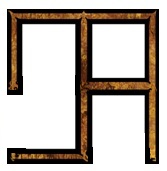
Giggle. I’m getting ahead of myself here. This post isn’t about Selayuth’s Hexaemeron, but rather about Hexaemer. Hexaemer was how I separated Reltash from the other worlds. Put simply, it is the written substance of reality, which Volianor used to shape the universe. I focused on the symbol


Which as you can see is made of six intersecting lines of equal length, six in six, if you consider perpendicular lines, which makes twelve. Ironically twelve is as important as six in Hexaemer, but more on that later.
The importance put on the value of each degree of ‘unmagiciness’ can’t be overstated. Each line is essentially another absolute law which has to be present in everyone and everything in the world in order for it to exist. The best way to look at this is through the scientific understanding of ‘dimensions’.
Since the dawn of geometry, three laws of dimension were immutable: an object has length, an object has width, and an object has height. Without one of these – no matter how small – an object is said not to exist. This is of course pure supposition and we can laugh at mathematicians because they can’t actually prove something won’t exist without one of these dimensions until they break their own rules. Ha ha. Anyway.

Then last century a fellow came along and said ‘what about time?’ and everyone else was like, ‘What about time?’ and he was like, ‘Well, an object can’t exist without being pinpointed somewhere within the spectrum of time either, so time is one of the cardinal dimensions’ and they were like,
‘Oh. Whoops.’
So now time, width, breadth and height are the four cardinal dimensions of our universe. That we know of. Naturally there is a good deal of argument about this, because there are supposedly dimensions human beings cannot fathom with only five senses, and others that they can’t prove to be essential one way or another. That’s where Hexaemer steps in.


To make things more confusing I inverted the lines. Blank spaces are representative of laws or ‘limitation’ whereas visible lines symbolise freedom and ‘possibility’. This is because rather than creating a world from nothing Volianor is in fact negating possibilities with strictures so as to shape structures, get it? Good.
Anyway, the most important of all the Sigils is the ‘Eternity’ symbol, and is the face of Hexaemer:

It also stands for other things like ‘possibility’ and ‘limitlessness’ (and ‘womb’ for the Kerowackians out there).
Next come the half-measure removals, things like


. There are twelve of these, and they are Reltash’s Absolute Dimensions.
Hang on, didn’t I just say there are only four dimensions on Earth? Why yes, esteemed reader, you are right. Have a biscuit.
I added and conjoined a few. Namely; temperature, illumination, density, size, time, corporeality, speed, sound, spectrality, colour, direction and meaning. I’ve decided that once these things reach any actual ‘zero factor’ the universe starts acting too darn strangely to be classified as ‘within the bounds of its universal dimensions’. What lies outside of those dimensions is another story.

Exciting, isn’t it? Not only do I get to write about diverse subjects such as history, biology and cosmology, but it falls to me to reinvent the very laws of nature. It’s slow work, but incredibly rewarding. I also expect at least some of my theories will be proven right over the course of time.
For example, Speed is considered a scalar quantity while Direction is a vector. This is a problem. I don’t know why, but it is.
I had to consider a new way to think of Direction as a scalar quantity. This wasn’t so hard. All you have to do is keep adding directions – which is fairly regular, since most things are moving down and elsewhere at the same time. I suppose the real problem is with the intensity of the Direction. For instance, Speed is scalar because no matter the number of speeds applied to an object it will still move, and that movement has a set rate. Direction can have any number of directions resulting in one overall trajectory, but that trajectory doesn’t have any degree of intensity... until you consider it as a tug of war. If several things are pulling an object in a single direction then it does have intensity, even though that intensity could easily succumb to a single larger pull in another direction. The trouble with science is that everything is always touching – temperature determines density determines size determines speed determines sound determines meaning etc. It all eventually blurs together – which is why without any of these things, I believe the rest would fall apart. Sure, I settled on twelve, but I’m sure there are more. Those twelve were just the focal point for a good story – and hey, I’m a writer before I’m a scientist.

Hexaemer is a language unlike any I have seen attempted in a fantasy setting – one that does not evolve or adapt, because it is considered perfect and sacred in its original form – kind of like how Sanskrit, Hebrew and Latin are viewed today. It also does not follow the classic function of most languages in that it is not meant to be easy to use or allow any instantaneous transfer of information. Its primary function is to describe something completely, along with its past and future, all it has caused and all it has affected. What’s more it is not so much a transcription of data so much as it is an ‘aura’ of data written into the very fabric of an entity, and even more pointedly, that fabric itself. The best way to look at it, I suppose, is as the smallest divisible unit of matter. As such even the most basic elements that comprise The Sixth World are made of words, whose bonds are in syntax and grammar rather than energy and valence. It isn’t difficult to imagine what it might be like; having one image made up of a thousand smaller images, and one of those images made up of a thousand more.

‘Magick’ on Reltash is a matter of knowing or ‘reading’ what makes up an entity, and then erasing certain words to substitute them with something else. It would be a highly complex field of study which requires years to breach.
Yet even so, I have to admit I am a great fan of the Dungeons & Dragons phenomenon, not only for the storytelling aspects but also for the strictures of the gameplay, where there are precise ‘classes’ to define what exactly a character can do. This ‘class’ system has carried over into so many different fields today that it is almost standard to think of books as a ‘magic story’, a ‘thief story’, or a ‘warrior story’ depending on the protagonist.
For those of you who have never had the pleasure of sitting around eating junk food with four or five friends rolling dice and rescuing fair maidens from the clutches of dastardly pony-thieves, there are two main magic-based classes in D&D: The wizard and the sorcerer. The wizard relies on intelligence and education, and is the more bookish – kind of what you would expect of Merlin or Dumbledore, locked up in a tower reading books and preparing everything in advance. This sort of fellow fits fairly well into the Hexaemeric universe. You can almost imagine him searching through ancient spellbooks for the name of one of the 602+ Sigils in the Hexaemeric alphabet to correctly structure a Hex with greater efficiency, and then painstakingly copying out streams of these runic letters to form a larger symbol.
The other kind, the Sorcerer, posed to be a bit of a problem. Sorcerers are ‘natural’ spellcasters, meaning that they are intuitively linked with the forces of the universe and can bend them at will. They do not have the brilliance of wizards, and thus their control over the forces of magic tends to be limited, but in whatever field they do have natural finesse they tend to excel all others. For example a sorcerer may have a knack for defensive spells and can conjure up barriers with ease, but unlike a wizard they cannot link their understanding of barriers to destructive spells because they have no true understanding of the ‘principles’ or ‘rules’ of magic.
On Reltash, sorcerers can be linked to natural speakers or talented musicians, who understand where to put notes and words to maximise their effect without really having an understanding of grammar or vocabulary. They have the ‘it’ factor, like when someone writes a book that just matches up with the thoughts and emotions of its readers without needing any complexity or schooled literary spirit behind it. Remember – everything in Reltash is made of words. Even gestures, exclamations and feelings can align to form a new phrase, and that phrase comes to life as magick.

I’ve gone a bit off track (and been hit by a train, no doubt) so I think I’ll end this one here.

The important points:

  • Reltash has 12 dimensions.
  • Reltash is made of words.
  • The 13 original words are the 12 dimensions and the concept ‘eternity’.
  • Reltash is the Sixth World in a line of several attempts to eliminate ‘possibilities’.

Friday, 13 January 2012

'Bring your reader to work' Day


It is dark outside. Technically as a day lasts 24 hours it still counts as a day, but in classic form the churning of many universes are preventing me from sleeping within my allocated 8 hour REM cycle despite self-hypnosis and that baby I ate two hours ago - jelly baby. That jelly baby I ate two hours ago, packed with simplistic amino-acid compounds that should have sent me into a sugar coma by now.

As you can see I am tired, I just can't sleep.

Picture, if you will, three objects in line. One of them is a super-mass structure with an insatiable gravity well, like a black hole. On the other end is a matter-less void - an equally insatiable vacuum sucking in whatever it can at the exact same intensity as the black hole. In the middle is World 1, the first world of creation. Because the Sixth World is made of 12 dimensions, the First World was made of 2. Behold my visual representationary prowess:


Working off the idea that the Dimensions are effect fields with fixed centers which generate a world when those fields overlap, and that those fields are affected by gravity and displacement or whatever their extra-dimensional equivalents are, we can assume that the shape of the world remains linear. There is an equal amount of force on each side, and thus the distribution of the dimensions is 1-1.
Skipping forward a few bagazillion millennia the first world collapses into a mini-well, and Volianor moves on to the Second World, a place with four dimensions which, I remind you, can border one another and overlap to a degree, but cannot occupy the same space:


Now the 'no simultaneous occupation of the same space' rule enforces a certain-if-not-definite rigidity in structure, but we can assume that if the dimensional fields have any wiggle room at all, they will be pulled towards the left, because there is now a greater force of gravitational attraction to the left (2-1). Later we have the Third World, Artash, a place with 6 dimensions:


This is where it gets interesting, because the 'no simultaneous occupation of the same space' rule has to be bent - five of the Dimensions can exist outside of the jurisdiction of the others, but the Sixth Dimension has to exist within 2 other dimensional fields, negating the property of independent existence. What's more it affects the other 2 dimensions, because now they exist within an additional dimensional field, implying co-dependence with the odd-Dimension-out.
While this is all very interesting, and could make for the basis of a great story, one also has to consider the integrity of the Dimensional Field: do they have to be circular/elliptical, or can they take up other shapes after they react to contact with other Fields and the pull of the spectral constants? For example, the above 'no simultaneous occupation of the same space' problem could be solved with oblongs:


This idea appeals not only because it's easier but there is no breaking out of any rule; merely the addition of another rule, such as, 'The field of effect surrounding a dimension may become irregular when exposed to external forces, but internal forces demand the volume of the field remains constant'.
From this point on we have not one possible universal form but two (three, actually, but I'll get to that in a minute): one in which fields maintain their integrity but dimensions cease to be independent, and another in which Dimensions maintain their integrity but fields cease to be independent. What's more important: the independence of the field, or the independence of the nucleus?
The real question being posed is whether the field is an area of decreasing dimensional effect, or if it is of equal value to the nucleus throughout its form. Can there even be 'degrees' to which a dimension applies? What are the properties such a state might imply - the ability to ignore or resist Dimension? Maybe. I'm always willing to accept possibilities.

Field Integrity suggests something different - that there are no degrees. A dimension either exists or it doesn't, and if it doesn't you cease to exist within the 'world'. This more closely represents the scientific beliefs of our own universe, but that is by no means any indication of accuracy.

The third thing to consider is whether or not moving towards the Vacuum increases the force acted upon the World by the Vacuum, as well as whether distance from the Gravity Well decreases the gravitational pull. Such additional considerations may actually balance out the force applied by the generated Worlds, and ensure that the dimensions remain equally-spaced. Considered further, that would deny the ability to change the Dimensional Fields' shapes to anything but other Dimensional Fields.

*Sleep overwhelms, thank goodness*

Assuming the effects do not balance, and continuing with the Uniform Field theory, we encounter the Fourth World and can imagine it looks something like this:


The more Dimensions I add, the more rigid the structure becomes, which is good. We now have 3 Dimensional Nuclei forced to reside within a minimum of two other fields, implying that those Dimensions themselves are an integral part of the others, as Socratic theory dictates an object cannot accept a quality into its form and remain stable if that quality is of an unlike state to the object.
The Fifth World:


A clear pattern is emerging where each dimension effects the 2 dimensions next to it.
At last, The Sixth World:


So that's model 1. I have, of course, assumed that Dimensional Nuclei attempt to establish a regular and equally-spaced form, and that's another of those things we can only make assumptions about on the 'what works small works big' principle. Such a compound is clearly highly resistant to external forces, because its internal bonds push it into an exact shape of minimum conflict (through polarity).

Naturally the question arises as to how we can be certain these laws work as they do, and as a simple librarian it isn't really my place to take up that battle. That's physics, and is a whole different field of inquiry.
As the curator of the Sixth World, it isn't my place to argue the physics on a representative level and mete out on such forces as 'probability'. My job is to record what I have discovered about the Sixth World, and from those facts that I know define the 'possible' laws that actually do apply in this small and singular situation. I am not a scientist in this sense, because I know I'm not going in blind. I already know that the Dimensional Architrave of The Sixth world is a crescent, like this:


This diagram, now that I am looking at it, implies several things:

  1. In Volianor's Totality, Dimensional Nuclei have spherical fields of influence around them.
  1. The 'energy' within these fields is not uniform, but is pushed away from other Dimensional Nuclei, resulting in large areas with little influence and 'lines' of maximised influence.
  1. The dimensions are organised in a crescent on the side of the Mass Field.
  1. 3 Cardinal points have allocated Dimensions. From top to bottom these are Time, Spectrality and Meaning.
  1. More dimensions exist within the lower half of the crescent, implying an outside force is pulling more powerfully in that direction than the other (or a force of repulsion is acting on the upper crescent). This is possibly the Fifth World.

In the end we are forced to consider a mixture of the two possibilities: the circle is the natural state of the field, as is field uniformity, but this natural state cannot remain stable in the presence of outside interference, and the field becomes elliptical and varied. In this way the nucleus is never directly exposed to the core values of another nucleus, but it does (given the presence of 6 or more dimensions) come into existence within another Dimensional Field, provided the Dimensional Nuclei do not arrive simultaneously. Either way, the fact that the spheres of influence touch explains why no single dimension can be affected without causing changes in the others. I'd even go as far as saying that those which border one another have direct relationships, while those that do not have indirect relationships.


So yes, all of this because I wanted to know why the Dimensional Architrave is a crescent. Being an Artist is a difficult quality to describe. Unlike scientists, we do not answer questions. We already have answers. Most of the time they just pop into your head and you think "Oh! That makes sense!".
What we can do is question those answers, and hope more things pop into our brains. To but it plainly, Artists work off different laws to those of the natural world, while scientists consult only the natural world.

A more complete look at Volianor's Totality can be seen below:

This image takes into account several cosmic events, such as the Third World Exodus, when several sentient species were propelled across the multiverse into the Sixth World, damaging the bindings on the dimension of Temperature; and the relocation of the Dragon Dream, when a parallel Sixth World (Asjai) began to fall apart and slowly funneled into the substance of Reltash, purportedly due to the actions of Demani, the Dream God.

All that's missing here is the creation of the seventh, eighth and ninth worlds, and the worlds I have not even begun to contemplate.